NEHW home page

History Highlights


Founders

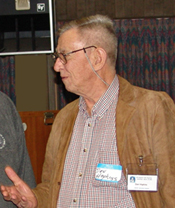
Neil Currie
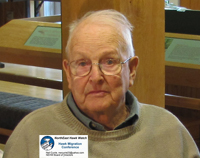
Don Hopkins
Jerry Mersereau
Jan Mitchell


Don Hopkins


Early Leaders

Paul Carrier
Seth Kellogg
Bill Welch


Related Links

NEHW

HMANA


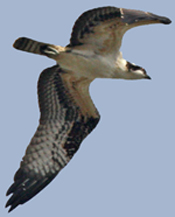
Osprey, in migration mode


NEHW
– A BRIEF HISTORY


By Neil Currie            


In 1971 a small group of Connecticut birders formed what they called The NEW ENGLAND HAWK WATCH.   Prior to that year they had been aware that each fall large numbers of hawks were migrating over Connecticut and on into New York and New Jersey.  Already in the East there were places where large numbers of migrating hawks could be observed in the fall:  Mt. Tom in Massachusetts, Montclair Quarry and Cape May in New Jersey and, since the 1930s, Hawk Mountain


Neil Currie

in Pennsylvania. There were even records from the late 1800s of  flights of  hawks over  New Haven, Connecticut.

The Connecticut group decided to learn more about hawk migration in Connecticut and the rest of New England. Visiting most New England bird clubs and sanctuaries they persuaded birders to spend three weekends in the Fall (two in September and one in late October) at a spot of their own choosing to count passing hawks.  At almost all of these new lookouts birders were surprised to see large numbers of migrating hawks.      
                                               

Part of the project was the help given by volunteer radio operators at some ground sites and the use of an airplane that hopefully could find and fly with the hawks. Radio operators could report hawks between lookouts and their location to the pilot and observer, ready to take off or already in the air.  However, after locating the hawks it was difficult to maintain contact with them because to stay in the air the plane had to fly much faster than the hawks.  After several years a much slower motor glider was located with Bill Welch as pilot and a NEHW organizer as an observer. If necessary the motor could be turned off so the plane could glide with the hawks. This proved successful over short periods of time but the glider still could not stay with the hawks for long. In his book, Hawks At My Wingtip, Bill describes his experiences and observations as he flew with the hawks. Each year, as reports were gathered from each site, Don Hopkins and Jerry Mersereau produced a report that went out to all the observers. This annual report, Hawk Migration, has continued to the present with Seth Kellogg as the editor. 

Over the years this array of weekend lookouts has evolved into a smaller group, usually about twelve, where hawks are watched for and counted over a ten day period in mid-September. This is the time when most Broad-winged Hawks are passing, headed south and southwest, and continuing on through Texas and into South America.  Two others, Quaker Ridge in Greenwich, and Lighthouse Point in New Haven, Connecticut , have operated since 1971,  maintaining daily watches in the fall season and each logging about 600 hours of watch time, from late August into early December.

Early in this history (
1974) some of the Connecticut group were involved in the formation of the HAWK MIGRATION ASSOCIA-TION of NORTH AMERICA (HMANA). Just as the name implies  HMANA became an association of nation- wide hawk watching groups whose paper records were funneled into one national archive. Now, with the availability of the internet, count records


Seth Kellogg

 go into an HMANA web site www.hawkcount.org. (See NEHW – What’s it All About). For the last few years (sponsored by Hawk Migration Association of North America, Hawk Watch International and Hawk Mountain Sanctuary) the recently formed Raptor Population Index (RPI) is using these counts  to contribute to  conservation and knowledge of raptors and their migration and to monitor population trends among the  different raptors.  

Larry Fischer & Paul Roberts


History Highlights:


1971

  Watch weekends begin.

  The New England Hawk Watch begins.

1973

Plane observations begin. Don Hopkins, Jerry Mersereau, Jan Mitchell, Neil Currie observe.

1974

  The Smirnoff Company donates the use of  a motor-glider. Bill Welch, pilot

  September 18 – The glider follows a continuous stream of Broad-winged Hawks from Amherst, MA to Carmel, NY for 100 miles

  The Hawk Migration Association  of North America organized.

Margery Pitcher conducts first  continuous fall watch at Lighthouse Point.

1975

United States Fish and Wildlife Service help to find use of motor glider owned by Andre Boesch of Danbury.

  Seventy weekend lookouts in September.

  Paul Carrier produces first of 35 consecutive newsletter covers.

1976

  22 Bald Eagles, 9 Golden Eagles counted in Fall flight in Connecticut

1978

  Robert Smart dies.

  Spring. NEHW sponsors a one-day conference in Holyoke, MA: 300 attend.

1979

  October 8:  3725 hawks in  New Haven. 2004 at Lighthouse Point.

1983

  September 13 -  Mt Wachusett, Princeton, MA:   19912 Broadwings.
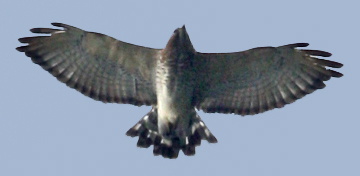
Broad-winged Hawk, still molting

Broad-winged Hawk

1984

  September 16 – Watertown, CT:  10007 Broadwings.

  September 16 – Mt. Wachusett, Princeton, MA:   4979 Broadwings.

  September 17 – Mt. Wachusett, Princeton, MA:   17415 Broadwings.

1986

  September 14 – Quaker Ridge, Greenwich, CT:   30535 Broadwings.

1987

  September 17 – Mt. Wachusett, Princeton, MA:   10095  Broadwings

1988

  September 16  - Quaker Ridge, Greenwich, CT:   13082 Broadwings.

1989

  September 13 – Mt. Wachusett, Princeton, MA:   15916 Broadwings.

  September 25 – Rye, New York:    16233 Broadwings.

1990

  April 7, Holyoke, MA:   NEHW Hawk Conference.

1991

  New England Hawk Watch becomes Northeast Hawk Watch.

1993

  March 19, Northampton, MA:  Northeast Hawk Watch Conference

  September 19 – Booth Hill, West Hartland, CT:   25176 Broadwings.

  September 19 – Harwinton, CT:   23318 Broadwings.

  September 19 – Quaker Ridge, Greenwich, CT:   22020 Broadwings.

  September19 – Montclair Quarry, Montclair, NJ:   14967 Broadwings.

  September 20 – Montclair Quarry, Montclair, NJ:   14015 Broadwings


NEHW – A Brief History: a work in progress by Neil Currie   


Photos by Trudy Battaly